Meta title: Freezer Frosting Over? Causes and Fixes | Klamath Falls
Meta description: Ice and frost building up in your freezer? Learn the real causes, a 10-minute home check, typical repair costs, and when to call a technician.
Frost on the walls or food in your freezer is a symptom, not the problem itself. If you’re dealing with freezer frosting over in Klamath Falls, the cause is usually moisture getting in through a bad door seal, or a failed defrost part that stopped clearing ice off the cooling coils. Most causes can be sorted out in under 15 minutes. This guide shows you how.
Table of Contents
Why Is Freezer Frosting Over in Klamath Falls Homes?
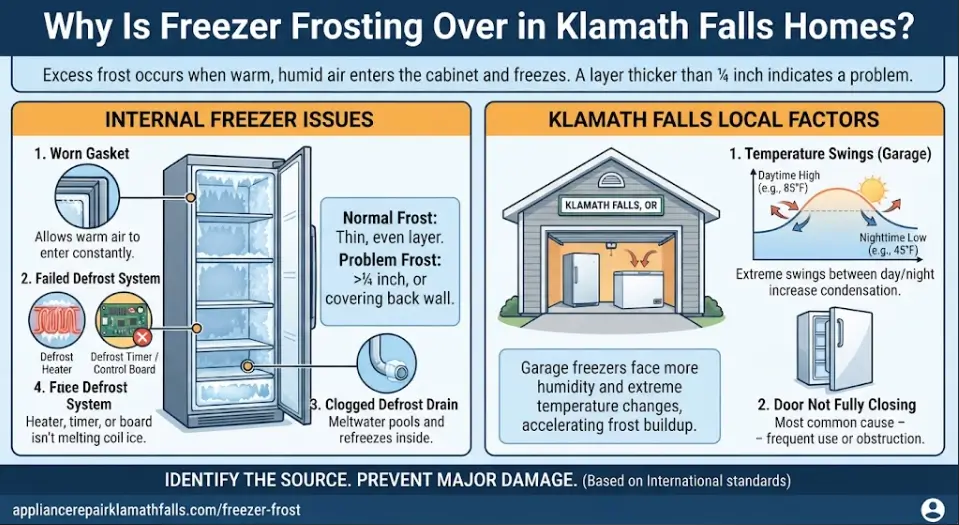
Quick Answer: freezer frosting over in Klamath Falls when warm, humid air enters the cabinet and freezes on the coldest surfaces. The most common causes are a worn door gasket, a door that doesn’t fully close, a failed defrost heater, defrost timer or control board, and a clogged defrost drain. Garage freezers in Klamath County also frost up faster during temperature swings between cold nights and hot afternoons.
Every time moisture enters the freezer, it turns to ice. A little frost is normal. A layer thicker than about ¼ inch, or frost covering the back wall, means something is failing.
The 7 Most Common Causes (and How to Spot Each One)
1. Worn or torn door gasket. Run your hand around the rubber seal. Cracks, flat spots, or a gasket that feels brittle let humid air leak in. Frost usually builds along the door edge first.
2. Door not closing fully. Overstuffed shelves, a tilted unit, or a basket sticking out can hold the door open a fraction of an inch. This is common in garage and basement chest freezers.
3. Failed defrost heater. Frost-free freezers melt ice off the evaporator coils on a cycle. If the heater burns out, ice builds on the back wall and eventually blocks airflow. Look for a thick frost sheet on the rear panel.
4. Bad defrost timer or control board. The heater can be fine while the part that tells it to run has failed. Same symptom: heavy frost on the back wall, with warm food in the fridge section above.
5. Faulty defrost thermostat or thermistor. This sensor tells the system when to start and stop defrosting. When it fails, the cycle never triggers.
6. Clogged defrost drain. Melted ice needs to drain out. If the drain freezes or clogs, water pools at the bottom of the freezer and refreezes as a solid ice block.
7. Blocked air vents. Packing food against the vents stops cold air circulating, which causes uneven temperatures and frost patches.
10-Minute Home Check Before You Call
- Do the dollar bill test. Close the door on a bill. If it slides out easily, the gasket isn’t sealing.
- Check that the door closes on its own. Open it halfway and let go. It should swing shut.
- Move food away from the vents and the back wall. Leave a couple of inches of clearance.
- Set the temperature to 0°F. Colder isn’t better and can increase frost.
- Look at the pattern. Frost on the door edge points to a seal problem. Frost on the back wall points to the defrost system.
- Do a manual defrost. Move food to coolers, unplug the unit, leave the door open, and let it melt for 24 hours. Dry the inside fully, then restart. If frost returns within a week or two, a defrost component has failed.
Don’t chip ice off the coils with a knife or screwdriver. Punctured refrigerant lines usually mean a replacement.
Klamath Falls Factors That Make Frost Worse
- Garage and shed freezers. Klamath Falls sits at roughly 4,100 feet, with cold winter nights and hot summer days. A garage freezer can swing from near freezing to over 90°F inside the room. Wide swings strain the compressor and thermostat, and humidity from a closing garage door adds moisture.
- Power outages. Winter storms and outages can interrupt defrost cycles and thaw food, which then refreezes as ice. If this happens often, see our guide on power outage appliance damage in Klamath Falls.
- Hard water from wells. Rural properties near Merrill and Malin often have mineral-heavy water. It clogs ice maker lines and drain tubes, which can cause leaks that freeze inside the freezer. Read more about hard water and Klamath Falls appliances.
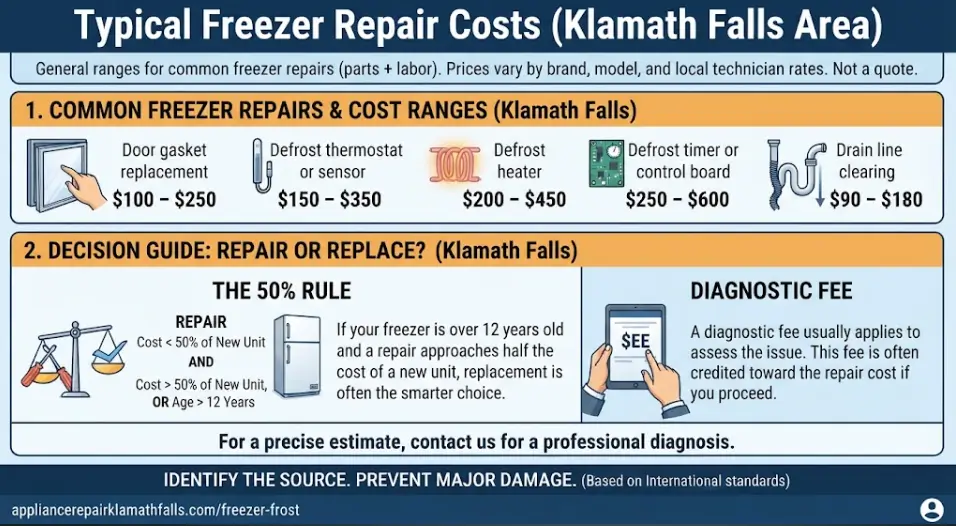
Typical Repair Costs
These are general ranges, not quotes. Prices vary by brand and model.
| Repair | Typical Range (parts + labor) |
|---|---|
| Door gasket replacement | $100 – $250 |
| Defrost thermostat or sensor | $150 – $350 |
| Defrost heater | $200 – $450 |
| Defrost timer or control board | $250 – $600 |
| Drain line clearing | $90 – $180 |
A diagnostic fee usually applies and is often credited toward the repair if you move forward. For a fuller breakdown, see appliance repair cost in Klamath Falls. If your freezer is over 12 years old and the repair is near half the price of a new unit, the 50% rule explained for Klamath Falls homeowners will help you decide.
Is the Food Still Safe?
Food that stayed frozen solid, or still has ice crystals, can generally be refrozen. Food that reached above 40°F for two hours or more should be thrown out. The USDA’s freezing and food safety guidance covers what to keep and what to toss.
When to Call a Technician
Call for help if:
- Frost returns within two weeks of a manual defrost
- The back wall is covered in thick ice
- Food in the fridge section is warm while the freezer is frosted
- The compressor runs nonstop
- Water leaks from the freezer onto the floor
Heavy frost on the back wall is a classic sign of a failed defrost part, and replacing it early prevents compressor strain. For same-day diagnosis from a team serving the greater Klamath Falls community, contact Appliance Repair Klamath Falls at [PHONE NUMBER]. You can also see our refrigerator and freezer repair service page. If the fridge section is struggling too, check why your refrigerator isn’t cooling or the signs your refrigerator is dying.
How to Prevent Freezer Frost
- Keep the freezer about 75% full, since a full freezer holds cold better, but don’t block vents.
- Let hot food cool before freezing it.
- Wrap or seal items to cut moisture.
- Open the door less and close it fully.
- Clean the gasket with warm soapy water every few months.
- Keep a garage freezer off bare concrete and away from the garage door.
- Review the U.S. Department of Energy’s refrigerator and freezer tips for placement and efficiency.
Freezer Frosting FAQs
Why is there so much frost in my freezer all of a sudden?
Sudden heavy frost usually points to a door that isn’t sealing or a defrost component that just failed.
Is frost in a freezer normal?
A thin layer is normal, especially in manual-defrost models. Anything thicker than ¼ inch is not.
Can a bad door seal cause frost?
Yes. A leaking gasket lets in humid air, which freezes on contact. It’s the most common and cheapest fix.
Why is frost only on the back wall?
That’s where the evaporator coils are. Frost there almost always means the defrost heater, timer, thermostat, or board has failed.
How long does a manual defrost take?
Plan for 12 to 24 hours with the unit unplugged and the door open. Place towels around the base.
Can I use a hair dryer to speed it up?
Use low heat and keep it moving, and never use it near standing water. Pans of hot water inside the freezer are safer.
Does a frosted freezer use more electricity?
Yes. Ice acts as insulation on the coils, so the compressor runs longer to hold temperature.
Why does my garage freezer frost more in summer?
Hot, humid air meets a cold interior each time you open the door. Heat around the unit also forces the compressor to work harder.
Can frost damage my freezer?
Over time, yes. Blocked airflow and nonstop compressor cycling shorten the unit’s life.
How do I know if the defrost heater is bad?
If the back wall frosts over repeatedly after a manual defrost, the heater is a prime suspect. A technician can test it with a meter.
Is it worth repairing an older freezer?
Usually, if the repair is under half the cost of a new one and the unit is under about 12 years old.
How quickly can a technician come out?
Many repairs are same-day depending on availability. Call [PHONE NUMBER] or visit appliancerepairklamathfalls.com to book.