A walk-in cooler that drifts past 41°F during a Friday dinner rush can cost you a week of inventory and a health inspection. Commercial refrigeration repair in Klamath Falls works best when you act on the early warning signs, not after the compressor quits. This guide covers what to watch for, what you can safely check yourself, what repairs usually cost, and how local conditions (high-desert heat, cold snaps, and power flickers) stress restaurant cooling equipment. Teams like Appliance Repair Klamath Falls handle these calls for kitchens across the area.
Table of Contents
When to Call for Commercial Refrigeration Repair in Klamath Falls
Quick Answer: When should a restaurant call for commercial refrigeration repair? Call right away if a walk-in cooler holds above 41°F for more than two hours, a freezer climbs above 0°F, the compressor runs nonstop, or you see ice on the evaporator coil or water pooling under the unit. Food held above 41°F can enter the “danger zone” where bacteria multiply fast, so same-day repair beats waiting for a full failure.
The FDA Food Code sets the 41°F cold-holding standard that most state and county inspectors follow. Oregon’s rules build on it, so a unit that cannot hold temperature is a compliance problem as well as a spoilage risk.
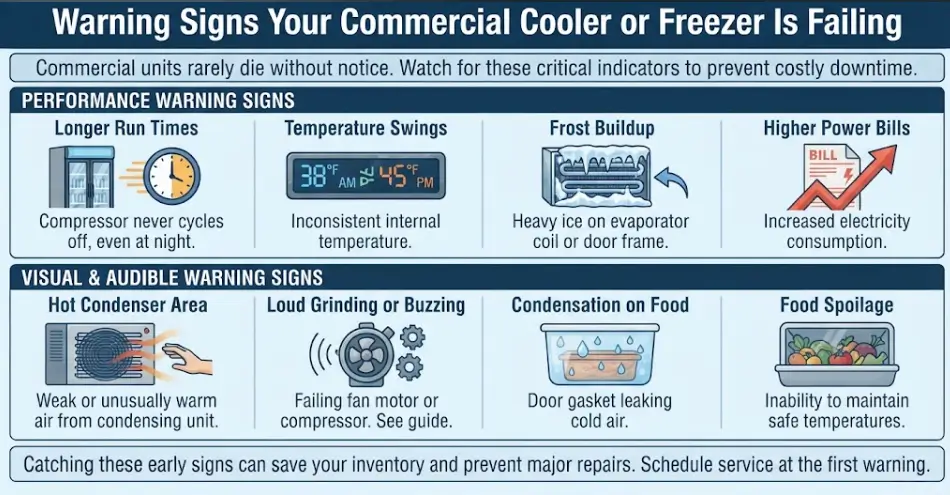
Warning Signs Your Cooler or Freezer Is Failing
Commercial units rarely die without notice. Watch for these:
- Longer run times. The compressor never cycles off, even at night.
- Temperature swings. The cooler reads 38°F in the morning and 45°F after lunch service.
- Frost buildup. Heavy ice on the evaporator coil or around the door frame points to a defrost heater, timer, or bad gasket.
- Hot condenser area. Air blowing from the condensing unit feels weak or unusually warm.
- Loud grinding or buzzing. This usually means a failing fan motor or a struggling compressor. Our guide on refrigerator noises and what they mean explains the sounds.
- Condensation on food or shelves. The door gasket is probably leaking cold air.
- Higher power bills. A failing system burns more electricity to hold the same temperature.
Why Klamath Falls Is Hard on Restaurant Refrigeration
Local conditions create problems you won’t find in generic repair advice:
- Summer heat at elevation. July and August afternoons often reach the 90s, and the dry air carries dust and pollen. Outdoor and rooftop condensers clog with debris, and a blocked condenser coil is one of the most common reasons a compressor overheats.
- Wildfire smoke season. Fine ash coats condenser coils and clogs air filters faster than normal. After a smoky week, inspect and clean your coils.
- Winter cold snaps. Units with outdoor condensers can struggle to maintain proper head pressure in very low temperatures, which causes short cycling.
- Power quality. Storms and utility switching can cause brief outages and surges that damage control boards and compressors. See our breakdown of power outage appliance damage in Klamath Falls.
- Seasonal demand. Tourist weekends and summer events push kitchens to run units harder, with more door openings and warmer product loads.
What You Can Safely Check Before Calling
These steps take about ten minutes and give your technician better information:
- Confirm the thermostat setting and check the display against a separate thermometer.
- Check the breaker and disconnect at the unit and the condensing unit.
- Look at the condenser coil. If it’s visibly caked with dust or ash, turn the power off and brush it gently. Never use a pressure washer.
- Inspect the door gasket. Close a dollar bill in the door. If it slides out easily, the seal is worn.
- Check airflow inside. Move boxes away from the evaporator fan so air can circulate.
- Listen for the evaporator fan. If the compressor runs but the inside fan is silent, say so on the call.
- Look for ice. A frozen coil usually means a defrost failure, not a refrigerant problem.
Do not open electrical panels, handle refrigerant, or jump components. Those jobs need a trained technician. If the cooler still isn’t cooling after these checks, our post on why a refrigerator is not cooling covers the common causes.
Common Commercial Refrigeration Repairs and Typical Costs
Prices vary by equipment, parts availability, and urgency. These are rough ranges to help you budget, not quotes.
| Problem | Likely Repair | Typical Range |
|---|---|---|
| Unit runs but doesn’t cool | Dirty coil cleaning, fan motor | $150 – $600 |
| Compressor hums, won’t start | Start capacitor or relay | $150 – $400 |
| Ice on evaporator | Defrost heater, timer, or sensor | $200 – $700 |
| Warm inside, loud outside | Condenser fan motor | $250 – $650 |
| Cold air leaking | Door gasket or hinge replacement | $100 – $400 |
| Display blank or erratic | Control board or thermostat | $200 – $800 |
| Compressor failure | Compressor replacement | $1,200 – $3,500+ |
A faulty compressor is the most expensive item on that list. Ask your technician whether the compressor failed on its own or because of a root cause such as a clogged condenser or low refrigerant. Replacing it without fixing the cause means a repeat failure. For general pricing context, read our appliance repair cost breakdown for Klamath Falls.
What to Do While Your Cooler Is Down
Your first two hours matter most.
- Keep the door shut. A full, closed walk-in can hold safe temperatures for roughly two to four hours.
- Move high-risk food first. Dairy, raw proteins, cut produce, and prepared items go into working reach-ins or insulated coolers with ice.
- Log temperatures every 30 minutes, with times. This record protects you in an inspection.
- Use the 4-hour rule. Per USDA guidance on the food safety danger zone, perishable food should not sit between 40°F and 140°F for more than two hours, or one hour above 90°F. Discard anything that goes past those limits.
- Call for service immediately and tell the dispatcher what the unit is doing, the model if you know it, and whether it’s a walk-in, reach-in, or prep table.
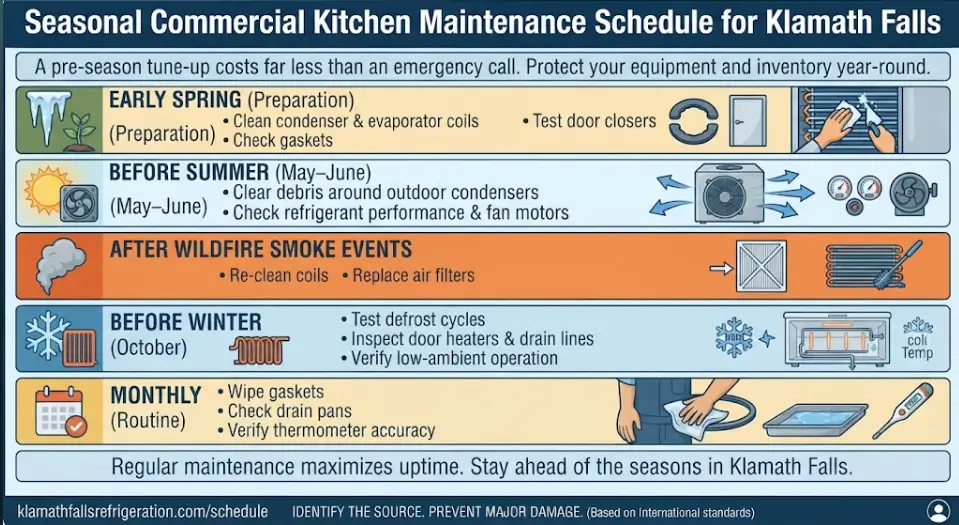
Seasonal Maintenance Schedule for Klamath Falls Kitchens
| When | Task |
|---|---|
| Early spring | Clean condenser and evaporator coils, check gaskets, test door closers |
| Before summer (May–June) | Clear debris around outdoor condensers, check refrigerant performance and fan motors |
| After wildfire smoke events | Re-clean coils and replace air filters |
| Before winter (October) | Test defrost cycles, inspect door heaters and drain lines, verify low-ambient operation |
| Monthly | Wipe gaskets, check drain pans, verify thermometer accuracy |
A pre-season tune-up costs far less than an emergency call during a holiday weekend. The same logic applies at home, as our winter appliance checklist for Klamath County shows.
Repair or Replace: A Practical Rule
Use the 50% rule. If a repair costs more than half the price of a comparable new unit, and the equipment is past 10 to 12 years old, replacement usually makes sense. Also weigh energy use, since older units can cost noticeably more to run. Learn more about the 50% rule and how it applies to your equipment’s age and repair history.
What to Expect When You Book Service
- Diagnosis first. A technician checks temperatures, pressures, electrical components, and coils before recommending anything.
- A diagnostic fee. This usually applies to the visit and is often credited toward the repair if you approve the work. Ask upfront.
- A clear estimate. You should get parts and labor in writing before work begins.
- Same-day repair when possible. Common parts like capacitors, fan motors, and gaskets can often be fixed during the visit.
Service covers restaurants, cafes, bars, and food-service operations throughout the greater Klamath Falls community. For homeowners dealing with the same problems, see our refrigerator repair services page. You can see everything we cover at https://appliancerepairklamathfalls.com/services/ or book through https://appliancerepairklamathfalls.com/contact/.
Frequently Asked Questions
What is the safe temperature for a commercial refrigerator?
Keep refrigerated food at 41°F or below and freezers at 0°F. Check with an independent thermometer, not just the built-in display.
How fast can commercial refrigeration repair in Klamath Falls happen?
Many calls for common issues like failed capacitors, fan motors, and gaskets are resolved the same day. Compressor replacements or special-order parts take longer.
How long does food stay safe if my walk-in cooler stops working?
A full walk-in with the door kept closed typically holds safe temperatures for two to four hours. After that, check food temperatures and discard anything above 41°F for more than two hours.
Why does my walk-in freezer keep icing up?
Usual causes are a failed defrost heater, defrost timer, or sensor, a worn door gasket letting in humid air, or a door left ajar. Heavy frost restricts airflow and makes the whole system work harder.
How often should restaurant refrigeration be serviced?
At least twice a year, with extra coil cleaning after wildfire smoke or heavy dust. High-use kitchens benefit from quarterly checks.
Can I clean the condenser coil myself?
Yes, with the power off, using a soft brush and a vacuum. Do not use water pressure or sharp tools, which can bend fins or damage components. If the coil is badly clogged, have a technician do it.
What causes a commercial compressor to fail?
The most common causes are overheating from dirty coils, electrical surges, low refrigerant from leaks, and running past the equipment’s expected life. Fixing the cause matters as much as replacing the part.
Do I need to replace the whole unit if the compressor goes bad?
Not always. If the unit is under about 10 years old and otherwise in good shape, compressor replacement can be worth it. On older units, compare the repair quote with replacement cost.
What information should I have ready when I call?
Equipment type, brand and model number if visible, what the unit is doing, the current inside temperature, and how long it has been happening.
Does a failing unit raise my electric bill?
Yes. Dirty coils, weak fans, and bad gaskets force the compressor to run longer. Our article on signs your refrigerator is dying lists the symptoms to watch.
Keep refrigerated food at 41°F or below and freezers at 0°F. Check with an independent thermometer, not just the built-in display.
Don’t Wait for the Rush to Find Out
If your cooler is running warm, cycling constantly, or icing up, call now while the fix is still small. Reach out through the contact page or phone, describe the symptoms, and get a technician scheduled.