If your fridge has been running warmer than usual or your energy bill keeps creeping up, dirty condenser coils are one of the most common—and most overlooked—culprits. Condenser coil cleaning in Klamath Falls homes needs to happen more often than the generic advice you’ll find online, mostly because of our high-desert dust, dry geothermal-heated air, and wildfire smoke season. This guide breaks down exactly how often to clean your coils, what happens if you skip it, and when the buildup means something more serious is going on.
Table of Contents
Quick Answer: How Often to Clean Refrigerator Condenser Coils in Klamath Falls
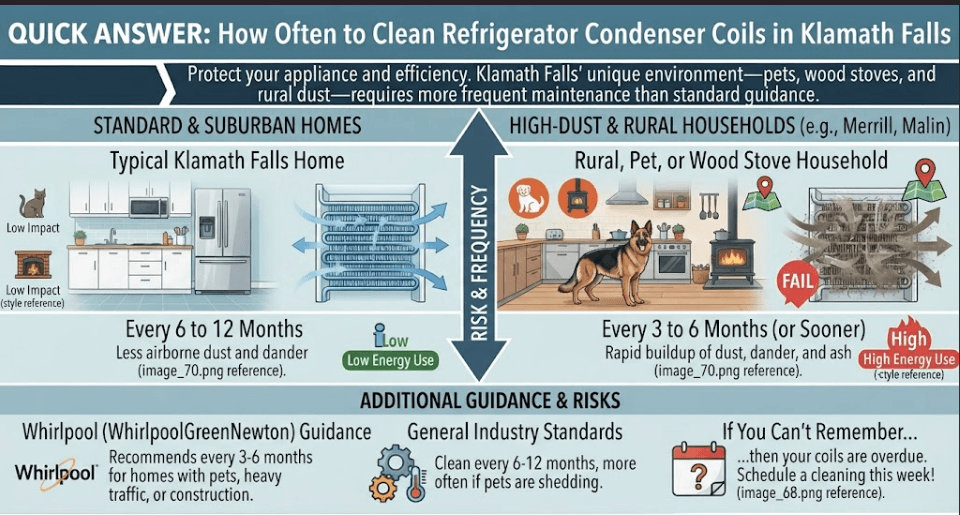
For most Klamath Falls households, refrigerator condenser coils should be vacuumed every 3 to 6 months. Homes with pets, a wood stove, nearby farmland, or a rural property in areas like Merrill or Malin should lean toward the 3-month mark because airborne dust and pet dander settle on coils faster than in a typical suburban home. Whirlpool’s own guidance recommends inspecting and cleaning coils every 3 to 6 months in households with pets, heavy kitchen traffic, or construction dust, and general industry guidance calls for cleaning every six months to a year, more often if pets are shedding in the home. If you can’t remember the last time you cleaned yours, that’s your answer—do it this week. whirlpoolgreennewton.
Why Coils Get Dirty Faster in Klamath Falls Homes
A few local factors push our coil cleaning frequency higher than the national average:
- High desert dust: Klamath Falls sits in a dry, high-altitude basin where dust and pumice particles from the surrounding volcanic soil circulate easily through open windows and HVAC returns.
- Wildfire smoke season: Summer smoke from regional fires leaves fine particulate residue on every surface in the home, including the back and underside of the fridge.
- Geothermal and forced-air heating: Many Klamath Falls homes rely on geothermal or forced-air systems that dry out indoor air and stir up dust faster than radiant heat.
- Rural and agricultural properties: Homes near Merrill, Malin, or the outskirts of Klamath County deal with more airborne field dust and pet traffic than in-town properties.
What Happens When You Skip Coil Cleaning
Dust-caked coils can’t release heat properly, which forces the compressor to run longer and harder to hit the same internal temperature. Over time this leads to:
- Higher energy bills as the compressor cycles more often
- Premature compressor wear or a full compressor failure
- Warmer-than-normal temperatures in the fridge and freezer
- Strain on the circuit board and other electrical components from overheating
- A shortened appliance lifespan overall
None of these problems show up overnight—they build gradually, which is exactly why coil buildup gets ignored until the fridge finally stops cooling.
Signs Your Condenser Coils Need Cleaning Right Now
- The fridge feels warm to the touch on the back or sides
- The motor runs louder or more frequently than it used to
- Food spoils faster or the freezer isn’t holding temperature
- Dust or pet hair is visibly matted around the coils or grille
- Your energy bill has climbed without a clear explanation
If you’re seeing several of these at once, check out our breakdown of 10 signs your refrigerator is dying to rule out a bigger issue before it turns into an emergency repair.
How to Clean Refrigerator Condenser Coils Safely
- Unplug the refrigerator or shut off the breaker—never clean coils while the unit is powered.
- Locate the coils. On most modern refrigerators they sit behind a base grille at the bottom front; older models have them mounted on the back.
- Remove the grille or access panel, usually held by clips or a couple of screws.
- Vacuum with a soft brush attachment or a dedicated coil brush to loosen and remove dust, pet hair, and debris.
- Use compressed air on tight spots the vacuum can’t reach.
- Wipe down the grille with warm, soapy water before reattaching it.
- Replace the grille and plug the unit back in.
Skip liquid cleaners near any wiring or the compressor housing, and never force a bent coil fin back into place—that can create a refrigerant leak.
DIY Cleaning vs. Professional Refrigerator Maintenance in Klamath Falls
Basic vacuuming is a fine DIY task for most households. But if the coils are heavily caked, if you can’t safely access them on a built-in or under-counter model, or if cleaning doesn’t fix the warm-fridge symptoms, it’s worth having a technician take a look. A faulty compressor, a cracked coil, or a failing circuit board can all mimic the symptoms of a dirty coil, and a same-day diagnostic visit is usually faster—and cheaper—than guessing. Our refrigerator repair Klamath Falls page covers what a typical service call includes and what a diagnostic fee usually runs.
Seasonal Condenser Coil Cleaning Schedule for Klamath Falls Homes
| Season | Why It Matters Locally | Action |
|---|---|---|
| Spring | Pollen and pumice dust pick up as the ground dries out | Vacuum coils, check door gaskets |
| Summer | Wildfire smoke season leaves fine particulate residue | Clean coils monthly if smoke advisories are frequent |
| Fall | Furnace and geothermal systems kick on, stirring dust | Vacuum coils before heating season starts |
| Winter | Homes stay sealed up, recirculating indoor dust and pet dander | Check coils at least once mid-season |
When to Call an Appliance Repair Technician in Klamath Falls
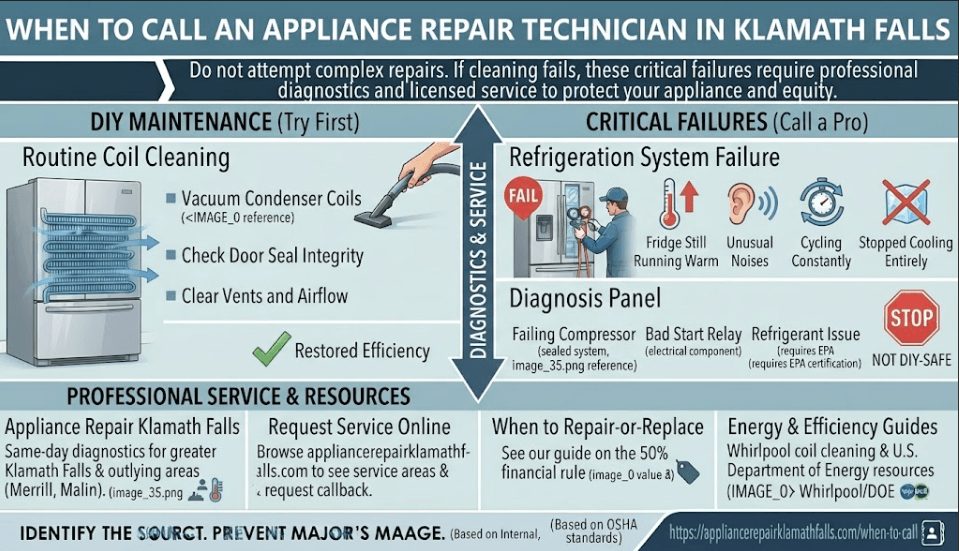
If you’ve cleaned the coils and the fridge is still running warm, making unusual noises, or cycling constantly, the problem likely isn’t dust anymore. At that point you’re probably looking at a failing compressor, a bad start relay, or a refrigerant issue—none of which are DIY-safe repairs. The team at Appliance Repair Klamath Falls offers same-day diagnostics for homes across the greater Klamath Falls community, including outlying areas like Merrill and Malin. You can also browse appliancerepairklamathfalls.com directly to see current service areas and request a callback.
For more on when a repair no longer makes financial sense, see our guide on the repair-or-replace 50% rule, and if you’re dealing with a fridge that’s stopped cooling altogether, this article on common causes of a refrigerator not cooling walks through the most frequent culprits.
For manufacturer-specific instructions, Whirlpool publishes detailed coil cleaning guidance for its refrigerator lineup, and the U.S. Department of Energy has a broader refrigerator maintenance and efficiency guide worth bookmarking.
FAQs
How often should I clean my refrigerator’s condenser coils in Klamath Falls?
Every 3 to 6 months for most homes. Households with pets, wood stoves, or a rural property should clean every 3 months due to higher dust and dander levels.
Can dirty condenser coils cause a compressor to fail?
Yes. When coils can’t release heat efficiently, the compressor runs longer and hotter than it’s designed to, which accelerates wear and can lead to early compressor failure.
Do I need to clean coils on a built-in or under-counter refrigerator?
Yes, though access is often trickier. Built-in models may require removing a front kick panel rather than a rear panel—check your owner’s manual or have a technician handle it.
Will cleaning the coils lower my energy bill?
It can. A refrigerator with clogged coils has to run longer cycles to stay cold, which uses more electricity. Clean coils restore normal run times.
Is it safe to clean coils myself?
Generally yes, as long as you unplug the unit first and avoid bending coil fins or touching wiring. If coils are hard to access or the fridge has other symptoms, call a professional instead.
What tools do I need to clean refrigerator coils?
A vacuum with a brush or crevice attachment, a coil cleaning brush, and optionally a can of compressed air for tight spaces.
Why do coils get dirty faster in Klamath Falls than other places?
Our high-desert climate, geothermal and forced-air heating, wildfire smoke season, and nearby agricultural land all contribute more airborne dust than a typical humid-climate city.
My coils are clean but the fridge still isn’t cold. What’s next?
That usually points to a bigger issue—low refrigerant, a failing compressor, a bad start relay, or a control board problem. At that point, a diagnostic visit from a local appliance repair technician is the fastest way to identify the cause.