KitchenAid dishwashers hold up well over the years, but every model eventually runs into the same handful of problems. Knowing what’s actually wrong before you call someone, or before you order the wrong part, saves time and money. This guide covers the most frequent issues we see on dishwasher repair Klamath Falls service calls, what typically causes each one, and when it’s worth handling yourself versus calling a technician.
Table of Contents
Quick Answer: What’s the Most Common KitchenAid Dishwasher Problem?

The most common issue is dishes coming out with a cloudy film or food residue, usually caused by a clogged spray arm, worn detergent dispenser, or hard water buildup. The second most common problem is the dishwasher failing to drain, typically traced to a clogged filter or a blocked drain pump. Both issues are diagnosable in under 10 minutes with the dishwasher powered off and the bottom rack removed.
Dishes Not Getting Clean
This is the complaint we hear most often, and it’s rarely the machine itself. Start by checking the spray arms for clogged holes, food debris and hard water deposits build up over time and block the jets that spray water onto dishes. Next, check the detergent dispenser door, if it’s not latching or opening fully during the cycle, detergent either dumps too early or doesn’t release at all. Klamath County’s water often runs harder than average, which speeds up mineral buildup inside the spray arms and filter screen faster than in areas with softer water.
Dishwasher Won’t Drain
Standing water in the bottom of the tub after a cycle almost always points to one of three places: the filter, the drain pump, or the air gap. The filter at the bottom of the tub catches food particles and needs manual cleaning every few weeks, it’s not self-cleaning on most KitchenAid models. If the filter is clear and water still isn’t draining, the drain pump or drain hose may be blocked with debris that’s harder to reach without disassembly. A clogged air gap, if your installation includes one, is another common and easy-to-check culprit.
Dishwasher Won’t Start or Won’t Fill
A dishwasher that seems completely dead usually comes down to one of a few things: a tripped circuit breaker, a door latch that isn’t sensing as fully closed, or, on newer models, the control lock feature being accidentally activated. Most KitchenAid models use a button-hold combination to toggle control lock, and it’s an easy setting to bump without realizing it. If the door latches properly and the breaker is fine but the unit still won’t start, the door switch itself may have failed and typically needs replacement.
Unusual Noises During the Cycle
A grinding or buzzing noise during the wash cycle is often the wash pump motor working around trapped debris, like a small bone fragment or piece of glass, that’s gotten past the filter. A different, more high-pitched squealing sound is more commonly linked to the drain pump. Because it’s difficult to tell these apart without opening the base of the unit, we recommend against running the dishwasher repeatedly once a new or unusual noise appears, since continuing to run it can cause a minor part failure to damage a second component nearby.
Error Codes
Modern KitchenAid dishwashers display error codes rather than leaving you guessing entirely, but the codes point to a general system rather than the exact part. An electronic control board issue often shows as a code referencing a stuck relay, while a code tied to the user interface panel can point to either a faulty touchpad or the control board itself. According to KitchenAid’s official troubleshooting guidance, it’s worth checking your model-specific owner’s manual for the exact code definitions before ordering parts, since the same code can sometimes mean different things across model years.
Leaking From the Door
Door leaks usually trace back to a worn door gasket, an overloaded lower rack pushing against the door seal, or too much detergent creating oversudsing that pushes water past the seal during the wash. Check the gasket for visible cracking or flattening first, since it’s the cheapest and most common fix. If the gasket looks fine and leaking continues, the issue is more likely a door spring, hinge alignment, or a cracked tub seam that needs a professional inspection.
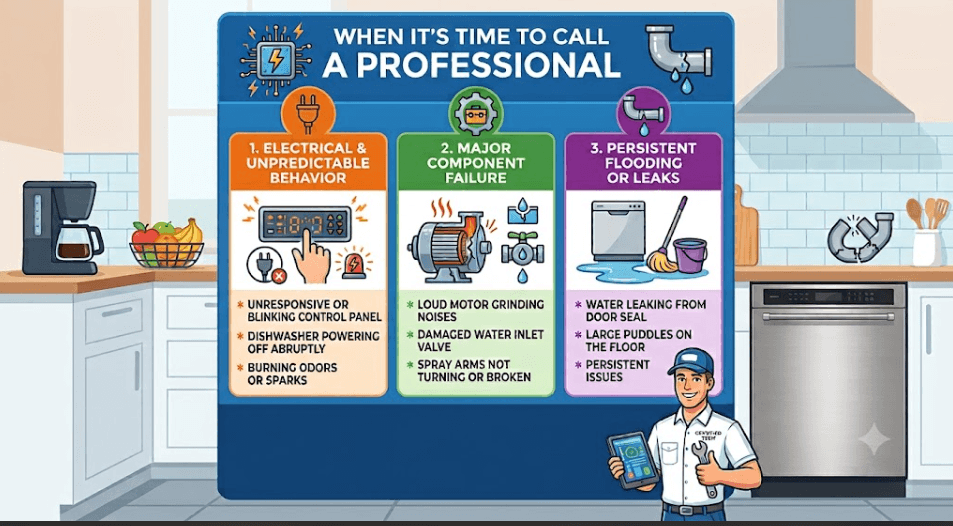
When It’s Time to Call a Professional
A few of these issues are simple enough to check yourself, spray arm clogs, filter cleaning, and control lock resets take just a few minutes. Others involve opening the base of the dishwasher, working near the control board, or diagnosing a pump that requires disassembly to access, and that’s where a wrong guess can turn a $150 repair into a $400 one. Our <a href=”https://appliancerepairklamathfalls.com/dishwasher-repair-klamath-falls/”>dishwasher repair services in Klamath Falls</a> cover KitchenAid units along with all major brands, with same-day diagnosis and upfront pricing before any work begins.
FAQs
Why does my KitchenAid dishwasher leave a white film on dishes?
This is typically hard water mineral buildup rather than a mechanical problem. Running a rinse aid consistently and occasionally running a citric acid or dishwasher cleaner cycle usually resolves it.
How often should I clean my KitchenAid dishwasher filter?
Every 2 to 4 weeks for most households, more often if you regularly run dishes with heavy food residue. A clogged filter is one of the most common causes of poor cleaning and drainage issues.
What does it mean if my KitchenAid dishwasher won’t start at all?
Check the circuit breaker first, then confirm the door is latching fully. If both check out, the control lock feature may be activated, or the door switch itself may have failed.
Is a grinding noise during the wash cycle serious?
It can be. A grinding sound often means debris is caught in the wash pump. Continuing to run the dishwasher with this noise present risks damaging the pump or motor further.
How much does KitchenAid dishwasher repair typically cost?
Simple fixes like a clogged filter or spray arm run on the lower end of typical appliance repair pricing, while control board or pump replacements run higher due to both part cost and labor time.
Can hard water damage a KitchenAid dishwasher long-term?
Yes. Consistent hard water buildup narrows spray arm jets, clogs the filter faster, and can shorten the lifespan of internal components if never addressed with a rinse aid or periodic cleaning cycle.
Should I try to fix a dishwasher error code myself?
For basic codes tied to the door latch or control lock, yes. For codes referencing the control board or user interface, it’s worth having a technician confirm the diagnosis before ordering a replacement part, since board issues are easy to misdiagnose.
Serving Klamath Falls, Altamont, Merrill, Keno, and Malin. Call (541) 919-6888 for same-day appliance repair.